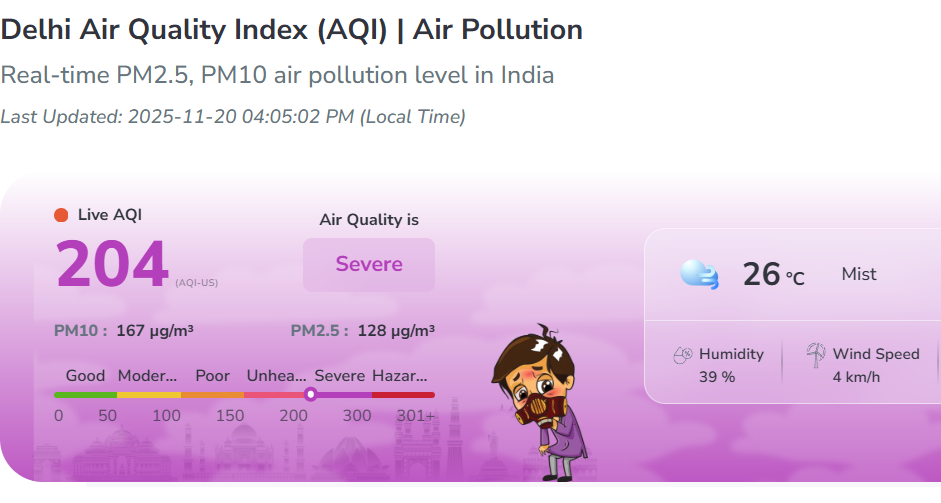
As of November 20, 2025, Delhi’s Air Quality Index (AQI) is in the “very poor” category, with an average of around 399, and several areas have slipped into the “severe” zone. The air quality has deteriorated due to stagnant atmospheric conditions and accumulated pollutants.
Key Details from News Reports
- Current AQI: The city’s average AQI was recorded at 399 at 9 am. According to the Central Pollution Control Board (CPCB), an AQI between 301-400 is classified as “very poor,” while 401-500 is “severe”.
- Hotspots: Locations such as India Gate (400 AQI) and other multiple localities have registered “severe” air quality levels.
- Forecast: The Indian Institute of Tropical Meteorology (IITM) forecasts that the air quality is likely to remain in the “very poor” to “severe” category for the next few days.
- Contributing Factors: Emissions from Delhi’s transport sector are the dominant contributor to PM2.5 pollution (around 18%), while stubble burning contribution has been relatively low (around 3.88%). Low wind speeds and high humidity have also hampered the dispersion of pollutants.
- Official Actions: Stage III of the Graded Response Action Plan (GRAP) is currently in effect across the National Capital Region (NCR), which includes measures such as a ban on non-essential construction and demolition activities and restrictions on certain vehicles. Reports of Stage IV being implemented were dismissed by the CAQM as “misleading information”.
Health Advisory
Health experts are calling the situation a public health emergency, recommending that vulnerable groups minimize outdoor exposure and follow precautions like wearing masks. Parents of several students have even moved the Delhi High Court to defer sports events during peak pollution months to protect children’s health.